Image credit: Unsplash
Imagine putting all your effort into organizing an online store. You ensure everything works well and looks good, but nobody can see it, let alone buy your products. It sounds scary, right? The reason why people can’t find your website may lie in the lack of search engine optimization (SEO).
SEO for eCommerce websites should take into account the peculiarities of online stores. For example, they usually contain fewer texts but more images than blogs. They may slow down website loading, so you need to dedicate more time to optimize website speed. You also need to choose the right keywords to attract relevant traffic and outperform competitors.
There are lots of strategies to win the attention of your target market on search engine result pages (SERPs). You also need to prove your credibility to search engines. That’s where you need an eCommerce SEO checklist to keep everything organized. We’ve prepared such for your online store. Let’s see how to boost your website rankings, bring traffic to the store, and increase sales.
Three Tips for Enhancing Your Online Presence with SEO
93% of online experiences are initiated on a search engine. SEO ensures you not only have visitors but also that these are relevant people. However, it’s not a quick process. As such, let’s proceed to concrete items you should include in your eCommerce website SEO checklist.
1. Conduct Comprehensive Keyword Research
Which terms do you employ when describing your offerings? The answer should be, “Those that my target audience utilizes when searching for the needed goods.” So, the first recommendation for the eCommerce SEO audit checklist is to review how your keywords perform and update them.
Use tools like Google Keyword Planner, SEMrush, or Ahrefs for keyword research. There, you can identify the best variants for your business to suit your niche. For example, if you sell handmade soap, you may see such keywords as “organic handmade soaps” or “biodegradable natural soap bars”.
Note: Don’t fall for short-tail keywords with high search volume. These keywords may entail more competitors using them. Look at long-tail keywords, longer, more specific phrases with less competition. They often mean more conversions thanks to driving people with the highest interest in purchasing. Dig them up with the help of a tool like LongTailPro.
Another important factor is knowing what people are searching for (understanding search intent). Tap into solutions like AnswerThePublic for insights into the real queries and expressions people use. Use this information to adjust the content to match it with the target audience’s search queries at various stages, such as:
- making a purchase;
- learning something new;
- comparing offerings.
SEO tools also reveal what keywords your competitors are ranking for. If specific terms, such as “organic scented bath soaps,” are gaining popularity on their websites, it indicates that these keywords have some value and can be worth implementing into your plan.
2. Utilize Advanced On-Page SEO Techniques
On-page SEO, also known as on-site SEO, is the process of improving different websites’ front-end and back-end elements. The aim is to help search engines understand the context and relevance of your material, resulting in better indexing and rankings. The on-page SEO checklist for eCommerce website involves the optimization of the components, including:
- content;
- site architecture;
- HTML.
Other on-page SEO techniques include:
- Creating Schema markup to help search engines understand the content of your webpage better. Use Google Structured Data Markup Helper to tag the page easily. Add rich snippets to make more information available in search results. It may help you stand out and generate a greater number of clicks.
- Working on meta descriptions. They shouldn’t exceed 160 characters but should have primary keywords and a CTA like “Discover more,” “Shop now,” or “Learn how”.
- Properly organize content using header tags (H1, H2, H3, etc.). One H1 tag per page and several H2 and H3 tags for subheadings. Avoid overuse of keywords.
- Optimizing images. Use descriptive, keyword-rich file names instead of “IMG_1234.jpg,” optimize Alt text, and compress images for faster loading.
3. Analyze Your Off-Page SEO
Off-page SEO denotes all activities performed outside the eCommerce website to promote it in search engines, such as:
- link building: earning links from other websites, producing valuable content to encourage people to share and link to it, contacting other website owners and requesting to link to your store;
- boosting social media engagement: employing SMM, working with influencers, responding to comments and answering questions, displaying user-generated content;
- promoting branded searches: podcasting, optimizing a Business Profile on Google, leveraging video marketing, and PR.
One of the best ways brands can strengthen their social media content strategy is by sharing and reposting what their consumers have created. User-generated content has greater viral potential than one that’s professionally crafted.
Why so? People like sharing their visuals with friends, family, and acquaintances on social media and treat photos and videos from real people as more genuine. Here’s an example of UGC on Levi’s Instagram account. You can see a separate folder with customers’ Instagram Stories and posts.
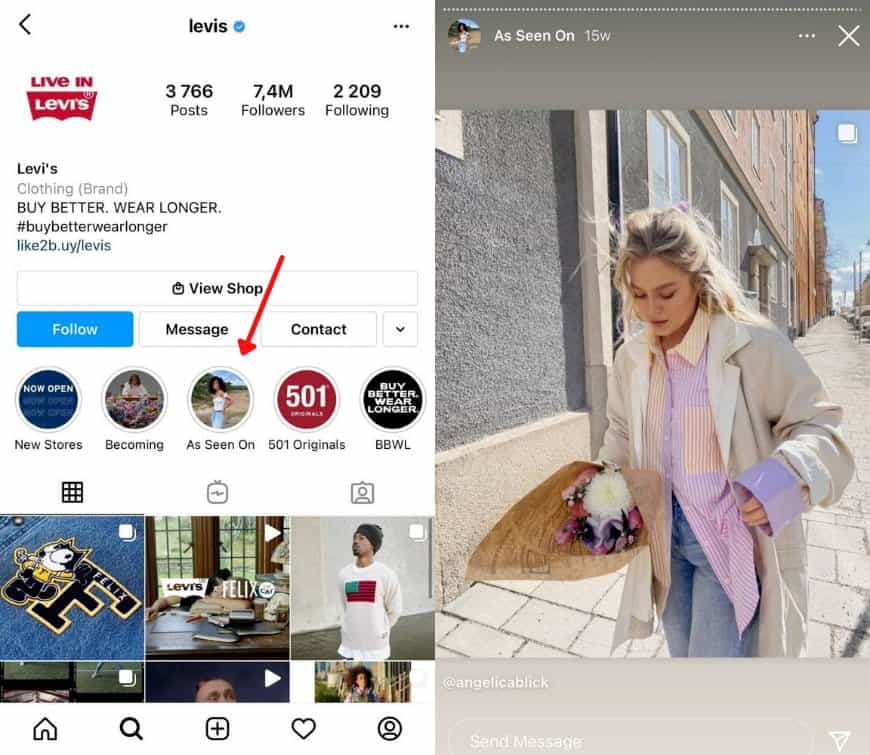
Screenshot of Levi’s Instagram account
To Sum Up
Here are some of the key steps you should take as part of your SEO checklist for eCommerce sites:
- Look for pertinent keywords;
- Create content that ranks well and hooks the user’s attention;
- Remove broken links and pages;
- Rewrite duplicate content or implement canonical URLs;
- Enhance the loading speed and optimize images;
- Get familiar with Schema markup, meta descriptions, and header tags;
- Earn backlinks and mentions by partnering with other website owners, influencers, and customers.
However, there is so much to do apart from that, like mobile optimization, local SEO practices, and creating site structure. That’s not to mention that the above-mentioned SEO domains also develop and change. Be aware of what’s going on in the industry. Regularly return to your website SEO and see what Google considers when ranking pages. Keep learning, keep optimizing, and most importantly, keep growing!

Kate Parish is the CMO at Onilab, a web development agency. Being a top executive in a company specializing in eCommerce, she spends much time researching new approaches in UX/UI design, Magento PWA development, and headless commerce on the whole. At the same time, Kate strives to keep up with the latest developments in digital marketing to modify the company’s promotional strategy accordingly. Her primary areas of interest are SEO, branding, and SMM. Finder her on LinkedIn.