This post may contain affiliate links and/or editorial content. Please read our disclosure for more information.
Manufacturing is one of those industries where every percentage point matters. Material waste, machine downtime, rework — each of these eats into margins quietly, and over time, the losses add up fast. If you’re running a manufacturing operation or sourcing parts for a product-based business, the equipment you choose has a direct impact on what you spend and what you keep.
Waterjet cutting has been gaining ground as one of the more cost-efficient methods for a wide range of materials, and the reasons why are worth understanding in detail. Here’s a breakdown of how this technology actually helps businesses cut costs — not just in theory, but in day-to-day operations.

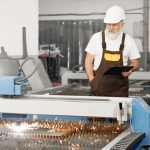
Photo credit: Bulat843 on Pexels
1. Less Material Waste Per Cut
One of the most immediate cost benefits is how little material gets wasted during cutting. Waterjet cutting uses a narrow, precise stream — typically between 0.02 and 0.05 inches wide — which means the kerf (the material removed by the cut) is minimal. On expensive materials like titanium, stainless steel, or carbon fiber, that precision directly reduces scrap.
In traditional methods like plasma or laser cutting, heat causes distortion near the cut edge, sometimes rendering portions of the material unusable. With waterjet, there’s no heat-affected zone, so more of what you buy actually ends up in your finished product.
2. No Secondary Finishing in Most Cases
Heat-based cutting methods often leave behind hardened edges, burrs, or discoloration that require additional finishing work — grinding, sanding, or chemical treatment. That secondary labor costs time and money on every single part.
Waterjet cuts produce smooth, clean edges that typically meet spec straight off the machine. For many applications, parts go directly from cutting to assembly without any additional processing. When you multiply that time saving across hundreds or thousands of parts, the operational impact is significant.
3. One Machine, Many Materials
Switching between materials on a traditional cutting line often means switching machines, tooling, or setups entirely. That transition time is non-productive — it’s money spent without output.
A waterjet machine handles an unusually broad range of materials — metals, composites, glass, stone, rubber, foam — with minimal changeover. Adjusting the water pressure and abrasive flow rate is typically all that’s needed to shift from one material to another.
OMAX Corp, a Hypertherm Company, is a well-known name in this space, and their systems are often cited in discussions around material flexibility and precision in industrial cutting environments. That versatility is worth noting for any operation that works across multiple material types.
4. Lower Tooling and Consumable Costs
Traditional machining relies on physical tooling — drill bits, saw blades, end mills — that wears out and needs replacement. That’s an ongoing cost that scales with production volume and gets expensive quickly, especially when cutting hard materials that accelerate tool wear.
Waterjet cutting doesn’t use mechanical contact. The cutting action comes from the water and abrasive, so there’s no tooling to replace after every run. The primary consumables are the abrasive material (usually garnet) and the focusing tube, both of which are relatively low-cost compared to CNC tooling or saw equipment.
According to the U.S. Department of Energy’s Advanced Manufacturing Office, reducing non-productive time and consumable costs are among the top drivers of efficiency gains in modern manufacturing. Waterjet’s design addresses both of these directly.
5. Reduced Energy Consumption
Energy costs are a significant operating expense in manufacturing, and they’re often overlooked when evaluating equipment. High-powered laser cutters and plasma systems draw substantial electricity during operation, and the cooling systems they require add to that load.
Waterjet systems are generally more energy-efficient for mid-range cutting tasks:
- They don’t require laser generation or high-frequency plasma arcs
- There’s no need for dedicated cooling infrastructure in most setups
- Pump systems can be throttled based on the job, avoiding unnecessary power draw at full load
Over the course of a year, those differences in energy consumption translate to a real difference in utility bills.
6. Fewer Rejected Parts and Rework Cycles
Rework is one of the most expensive problems in manufacturing — not just for the direct labor cost, but for the scheduling disruption it causes. A part that needs to be redone delays everything downstream.
Waterjet cutting is highly repeatable. Once a program is set, the machine replicates the same cut geometry precisely, part after part. The lack of thermal distortion and the tight tolerances achievable with modern waterjet systems mean rejection rates are low for most applications.
For small-batch production or custom fabrication, that reliability is especially valuable. You’re not building in a buffer for expected rejects — you’re cutting what you need and getting it right.
Conclusion
Cost efficiency in manufacturing isn’t usually the result of one dramatic change. It comes from compounding small improvements across material use, labor, energy, and rework. Waterjet cutting addresses several of those levers at once, which is why it’s worth serious consideration for operations looking to tighten margins without sacrificing quality or capability.
If you’re evaluating equipment options, understanding how each method performs across these dimensions — not just the upfront price — will give you a much clearer picture of the actual cost.