Managing a small business often requires strict control over spending. Advertising, especially pay-per-click, can seem risky when funds are limited. However, PPC is not inherently expensive. When planned and executed thoughtfully, it allows small businesses to stay competitive and achieve measurable results while keeping costs under control.
Run Profitable PPC Campaigns on a Tight Budget

Start Small and Test Everything
The biggest mistake small businesses make is launching large campaigns right out of the gate. Instead, start with a modest daily budget, even $10 to $20 can provide valuable insights. Use this initial phase to test different ad copies, keywords, and audience segments.
Monitor which ads generate clicks, which keywords convert, and what times of day perform best. This data becomes the foundation for scaling what works and cutting what doesn’t.
Focus on Long-Tail Keywords
While competing for broad keywords like “shoes” or “lawyer” requires deep pockets, long-tail keywords offer a budget-friendly alternative. These are longer, more specific phrases that potential customers use when they’re closer to making a purchase decision.
Instead of bidding on “coffee shop,” target “organic fair trade coffee shop in Brooklyn.” These keywords cost less per click because there’s less competition, and they attract highly qualified traffic. Someone searching for something specific is usually further along in the buying journey.
Leverage Geographic Targeting
One of PPC’s most powerful features for small businesses is geographic targeting. If operating a local business, there’s no need to pay for clicks from people who will never visit.
Use radius targeting to show ads only to people within a specific distance from the location. A local bakery can target people within five miles, while a service provider can extend to 25 miles. Geographic targeting also allows for customizing ad copy to mention local landmarks, making ads more relevant and clickable.
Master the Art of Ad Scheduling
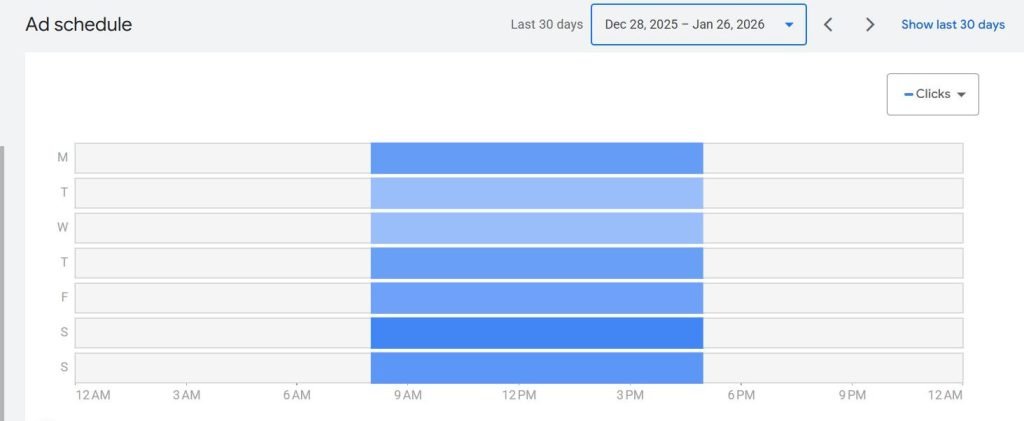
PPC results can vary significantly depending on the time of day your ads are shown. Use ad scheduling to show ads only during times when the target audience is most active or when the business can respond to inquiries.
Ad scheduling helps in several ways:
- A B2B company can pause ads during evenings and weekends when decision-makers aren’t actively searching.
- A restaurant could increase bids during lunch and dinner hours when people are planning meals.
- Service businesses can align ads with actual business hours to ensure availability when potential customers call.
Review performance data by hour and day of the week, then adjust schedules accordingly to avoid wasting budget on times that don’t convert.
Source : Slice Pizzeria
Use Negative Keywords
Negative keywords prevent wasted clicks from people looking for something different. They tell ad platforms which searches should NOT trigger ads.
A luxury watch retailer should add “cheap,” “free,” and “used” as negative keywords. A law firm or attorney specializing in business law should exclude “criminal” or “divorce.” Creating a thorough negative keyword list helps filter out unwanted traffic, significantly reducing wasted clicks and improving overall campaign efficiency.
Review search term reports weekly and continuously add new negative keywords based on actual search queries.
Optimize Landing Pages for Conversions
Even perfectly targeted ads are wasted if they send visitors to poor landing pages. The landing page experience directly impacts both conversion rates and Quality Score — a metric Google uses to determine ad costs.
Ensure landing pages are mobile-responsive, fast-loading, directly relevant to the ad copy, and clear about the next step with prominent call-to-action buttons. An effectively optimized landing page can significantly boost conversions, helping you generate more customers without increasing your advertising budget.

Source: Peak Gear
Take Advantage of Ad Extensions
Ad extensions are free additions to ads that provide extra information and take up more space on search results. They increase visibility and click-through rates without adding costs.
Useful extensions include:
- Call extensions that let mobile users tap to call directly
- Location extensions showing the business address
- Sitelink extensions highlighting specific pages or offers
- Callout extensions emphasizing unique selling points
Using ad extensions often leads to noticeably higher engagement, as they tend to attract more clicks and offer one of the simplest ways to enhance overall ad performance.
Monitor and Adjust Constantly
PPC requires ongoing attention and refinement rather than a one-time setup. Set aside time weekly to review ecommerce performance metrics: check which keywords are driving conversions versus just clicks, pause underperforming ads, test new ad copy variations, and adjust bids based on performance.
This hands-on approach ensures the budget always flows toward what’s actually working. Even small adjustments can meaningfully impact results over time.
Set Clear Goals and Track ROI
Before spending anything on PPC, define what success looks like. Is it phone calls, form submissions, online purchases, or foot traffic? Set up proper conversion tracking to measure these actions.
Understanding the actual value of conversions helps determine how much to spend per click. When you understand the long-term value of a customer and how many leads typically turn into sales, it becomes easier to set sensible limits on what you can spend to acquire each lead. This perspective shifts the focus away from worrying about individual click costs and toward measuring true return on investment.
Final Thoughts
Small businesses can absolutely succeed with PPC on limited budgets. The key is to approach it strategically by starting small, targeting precisely, optimizing continuously, and eliminating unnecessary spend at every stage.
Results may take time to materialize, but with consistent effort and insights drawn from data, PPC can evolve into a dependable customer acquisition channel without the need for large ad spends. The businesses that thrive are those that treat PPC as an ongoing experiment, constantly learning what resonates with their audience and doubling down on what works.

Tina Bahadur is a Social Media Ads Expert at SevenAtoms, where she has spent 7-plus years growing client accounts. You can find her on the weekends enjoying San Francisco Bay Area hikes with her family, checking out new restaurants, and playing table tennis.