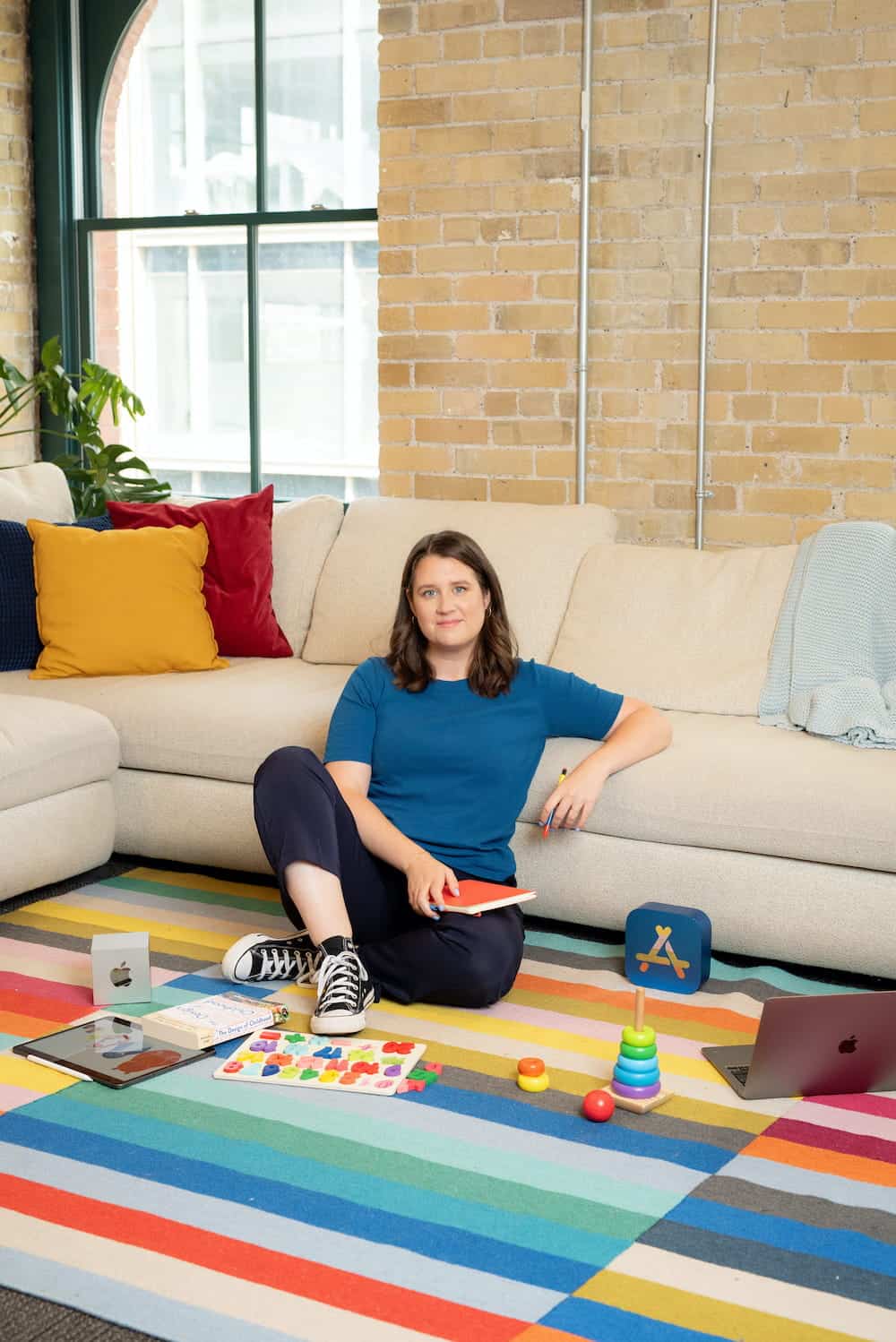
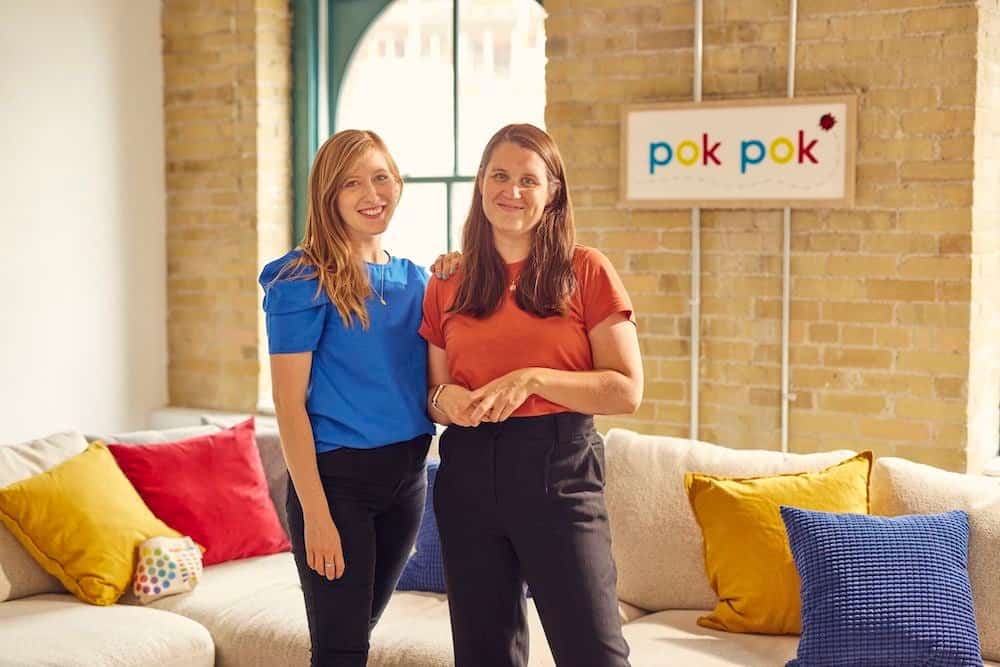
The idea for Pok Pok began with a mom who was tired of seeing the same overstimulating, ad-ridden screen time options offered to her kids. Co-founder Esther wanted something as safe, educational, and low-stimulation as the toys her kids used at home. That’s why she created Pok Pok, a Montessori-inspired learning app for kids 2-7 that is designed to be non-addictive and low-stimulation. Three years later, Pok Pok is one of the fastest-growing kids apps in the US, disrupting a market dominated by fast-paced games with its gentler approach.
Like many young parents, Esther Huybreghts found herself looking for appropriate screen time solutions for her toddler. She wanted him to develop a healthy relationship with technology, but couldn’t find any options she felt good about. With her skills in illustration and animation, and a stubborn “how-hard-can-it-be” gene, she and her husband set out to create their own children’s app as a small hobby project for their family. A couple of years later, together with co-founder and CEO Melissa Cash and a stellar team, they launched Pok Pok, a Montessori-inspired kids’ app to help families all around the world finally feel confident about their screen time choices.
Takeaways:
Nothing has changed in kids’ media for a long time. With Pok Pok, Esther Huybreghts challenged the status quo and turned screen time upside down.
Screen time isn’t inherently good or bad. It all depends on what your family’s needs are at that moment.
Can you start by introducing yourself and telling us in your words, about your inspiring story?
I’m Esther. I live, work, and raise my kids together with my husband Mathijs Dmeaeght in our small farmhouse in Belgium, right on the border with France. I started Pok Pok, a Montessori-inspired kids’ app to give kids a digital tool to spark their imagination, find their confidence, and play and learn at their own pace.
We’d love to learn more about how you got to where you are today.
It’s always the small choices we make along the way that bring us to where we are today, and for me, that’s no different.
Back in early 2018, I was a young mother of a toddler and a newborn. The newborn was an intense baby with a difficult start, and I felt a postpartum depression lurking around the corner. I knew from my first postpartum experience that I needed to get my creative juices flowing to help me find my way back to myself.
Around the same time, my husband and I were looking for screen time options for our toddler to keep him occupied safely while we tended to the baby. My husband was working in game design, and we wanted to give our kid the opportunity to build a healthy relationship with technology—but none of the options for kids’ apps felt right for our family. They were either addictive and overstimulating, or complicated and way above his skill level. We were hoping to find a digital version of the playroom in our house, where he could simply extend his open-ended style of play on a screen, but it didn’t exist.
Even though we had no experience with app design whatsoever, we decided we would make a small app ourselves, in our spare time. Our little boy loved look-and-search books, so we came up with an encyclopedia-like concept with all kinds of animated people, objects, and animals. Even in its most crude, basic prototype, our little boy adored it.
We showed this prototype to our colleagues and got in touch with Melissa Cash, one of their family members. Our little idea sparked a big conversation about the role of technology in kids’ lives, how lacking it had been, and what it could be. A year later, we officially started our journey together with Melissa, to bring Pok Pok to families all around the world.
Can you explain a little bit about your product?
Pok Pok is a Montessori-inspired app for kids aged 2-8, featuring an ever-growing collection of digital “toys”. It’s a kids’ app unlike any other. Most kids’ apps parents are familiar with feature complicated menus, annoying music or voices, levels to beat, and points to score. All of these features make for addictive, dopamine-inducing screen time options that kids find very hard to put away and leave parents frustrated.
With Pok Pok, we decided to rethink the way kids interact with a screen from the ground up. The digital toy box with activities closely resembles the type of toys we all grew up with. There is a marble maze, a town that looks like those “city play rugs”, a dinosaur world, a doll house, and so much more—but without the objectives most other games have. A pile of wooden blocks isn’t going to applaud your child when they build it into a tower or punish them when they topple it over. Maybe the child’s intent was to topple it over? Who are we to say which kind of play is right or wrong, when the intent is to explore, to create, to imagine, to tell stories?
Pok Pok also strives to be the most inclusive kids’ app. We show people and families of all genders, cultures, constructs, and abilities, to highlight the diversity in this beautiful world of ours. Kids deserve to see themselves and their families represented in the media they consume, and we strive to give them just that.
But inclusivity is more than just visual representation—Pok Pok also has a unique, minimal interface, making play as easy as picking up a toy from a shelf and getting started. There is no text to read, no complicated menus to unravel, no levels to beat before you can move on—so it’s accessible for even the youngest of players.
How did you market your business when it was brand new?
We didn’t do paid marketing for a very long time and relied on PR and our accolades to boost word of mouth organically. Our connections with technological publications which helped amplify the release, but we were a bootstrapping start-up and relying on word-of-mouth from enthusiastic parents to get the ball rolling. Three weeks after launch, we won an Apple Design Award, which really kicked our launch into a higher gear, and that helped propel us forward.
What is a typical day like for you?
As the Chief Creative Officer, I oversee the vision for the product and the brand, guiding product decisions well into our future. My husband and I are the only people on our team located in Belgium, with the rest of them in Canada. The 6-hour time difference breaks up my day into two chunks: work time and meeting time. From 9 AM to 3 PM, I have heads down working time, where I develop new concepts for toys, do research, or actively work on a toy—I’m an illustrator at heart and I love to be able to add to the activities we’re building.
At 3 PM, when my Canadian team starts their workday, I have a couple of meetings. I have a hard stop at 5PM, when I make dinner and spend time with my kids (who have now grown into full-blown school children). After their bedtime, about half of my week, I will have additional meetings, but I also try and safeguard some evening time each week where I can turn off my computer.
If you had one piece of advice for someone just starting out, what would it be?
I think one of the most important pieces of advice I could give is: testing, testing, testing! With kids as our core audience, we have the benefit of a brutally honest opinion. There is no sugarcoating: if they don’t like what you’ve made, you’ll hear about it. It forces us to look into the mirror daily and adjust.
That’s not to say we haven’t made our share of mistakes, but when we do, we take it as a new opportunity to listen to our user base and fix our wrongs. I’m so grateful for a vocal community that knows how easily they can reach us.
“I never started Pok Pok with the intent of making the world’s best kids’ app. I just wanted to make something that would, finally, meet kids at their own level, wherever that may be.”
– Esther Huybreghts
Every entrepreneur has a goal and problem they’re trying to solve. What was the inspiration that started your journey?
My own inspiration was just the lack of options for my children where screen time was concerned. It seemed like the kids’ apps available were just games with addictive adult game mechanics and a kids’ IP slapped on there. The other branch was the educational kids’ apps, but again, they started from the idea that learning was inherently boring and kids should be bribed and tricked with cheering sounds and points to collect, just to try and get them to keep playing. It felt so counterintuitive to how I learned as a child, and how I was seeing my own kids grow up. We needed to do better for our own kids.
How do you prioritize self-care and well-being while managing the demands of your business?
It’s honestly incredibly hard. As a person with ADHD, I struggle with impostor syndrome and a constant fear of failing my team, so it’s hard to set boundaries when it comes to work—it’s always a struggle to tell myself I’ve done enough. Luckily, I’ve found a couple of hobbies like gardening, painting miniatures, and reading, that help me turn off my screen and do something completely different, that talk to different parts of my brain. In turn, I feel like all those things inspire me and help me find my confidence in my work.
What would you consider your biggest accomplishment and why?
We have won numerous awards, amongst which a highly coveted Apple Design Award and an App Store Award, and I’m so incredibly proud of those—but in the end, my biggest motivator will always be the children and their families. We’ve gotten so many messages over the past few years of parents taking the time to write to us, telling us the impact we’ve made on their families. I will always be so grateful to have the opportunity to improve children’s lives even a little bit.
We all face challenges. Looking back, what have been some of the biggest challenges and obstacles you’ve had to navigate?
One of our biggest challenges is the fact that our user is not our customer. As a kids’ product, we first have to target the parents, and convince them to give Pok Pok a shot. Most parents are looking for educational screen time, to ease their guilt over letting their kids use a screen. Kids learn best through play, and that idea is ingrained into our core product—but if parents don’t see letters or numbers and things they can quickly recognize as “educational”, it can be harder to convince them of Pok Pok’s educational merit. As adults, parents are so conditioned on the way things are (like what a game is supposed to look like) that they have a hard time understanding what Pok Pok is about. I always say: Just give it to your kid, they will know what to do!
What challenges have you faced in the workplace, especially your experience in male-dominated environments?
Being a female-founded company, we are very careful with the people we’ve hired onto our team to uplift our company culture. Respect, inclusivity, honesty, and transparency are all of the utmost importance to us.
When we started raising our series A, it was a priority to ensure female presence on the cap table. However, it proved to be a serious challenge, as female capital often doesn’t move into the series A brackets. With the help of our lead investor, we actually did a secondary close on the series A just so we could keep looking for a female presence amongst our investors. It worked out so well, and we are thrilled with all of our investors and their advice and experience.
How do you set your business apart from others in your industry?
As a company that makes screen time products, there’s already so much distrust from parents. Most of us have a less-than-stellar experience with social media, the addictive nature of screens, and a never-ending cycle of balancing a few minutes of peace with a tantrum of our kids later on.
Because our core product is already so different from our competitors, with soft sounds and hand-drawn animations (like they used to make the old Disney movies), and without the addictive gameplay mechanics like points to score and levels to beat, we’re already a step ahead from our competitors. Additionally, parents can request a physical play kit in the Grown-Up area of our app, which includes a handwritten note that we’re sending out via snail mail. It really helps change the idea of the invisible tech giants in their ivory towers—in the end, we’re just a couple of parents trying to make the world a little bit better.
In the end, I never started Pok Pok with the intent of making the world’s best kids’ app. I just wanted to make something that would, finally, meet kids at their own level, wherever that may be. In a world where most decisions are made for them, we give them the opportunity to decide how they want to play.
What are the three most important habits to be a successful high performer or leader?
Exercise playfulness! As adults, it’s all too easy to become stuck in the to-do lists of life, but at Pok Pok, I always make sure to try and incorporate play and joy as often as possible in our daily lives. We try to have a company-wide toy brainstorm a couple of times a year to maximize all of our team’s strengths, both known and uncharted, to come up with new toys. “The best idea wins” is something we always strive for, whether that comes from someone on the product team or the admin team.
We also always strive to have an open line of communication with our team. As a leader, I want to be as open and transparent as possible with them. We implemented quarterly Town Hall meetings to keep people in the loop on big decisions we’re making as leaders, giving them insights and a voice.
Lastly, I think it’s important to stay curious and don’t be afraid of shaking things up. Pok Pok would never have made the dent it has if we stuck to the status quo. By changing the way kids interact with digital media from the ground up, we were able to finally turn around how parents feel about their kids’ screen time habits.
Which female leader do you admire, and why?
There are many female leaders I admire, like Michelle Obama, Kamala Harris, or Jacinda Ardern—they are widely celebrated and recognized. I’m incredibly hopeful for the younger generation like Greta Thunberg and Malala Yousafzai, who are shaping the world and we get to be the audience, the uplifter, the ally.
But in particular, I want to uplift my co-founder and our CEO, Melissa Cash. With her, I’ve found the yin to my yang. She’s as headstrong and stubborn as they come, a fierce believer in our mission, an incredible mother, and in just a few years she has become one of my dearest friends. I feel incredibly lucky to be building a company like this with a woman like her.
Do you have a favorite quote or motto that inspires you?
Melissa and I have jokingly made our leadership motto: “We’re doing great!”. It’s a way to uplift each other when we’re facing a challenge, a chant to celebrate a win, and manifestation when we’re looking to the future. It’s such a simple, silly phrase, yet it holds so much power for us.
Conclusion
I’ve always jokingly, lovingly called Pok Pok my third child, and in a way it definitely is. I’ve seen first-hand the impact good screen time can have on families, who would’ve felt guilty in the past for making screen time choices society doesn’t always agree with. Knowing the product I came up with for my own little family, which was never meant to be anything more than that, now helps tens of thousands of families around the world find rest, play, and learning, is what makes me get out of bed in the morning.
Follow along with our journey on socials @playpokpok!
Want more inspiring interviews?
We love spotlighting amazing women! Check out these interviews (plus so many more) on She Owns It.
Meet Shira Yevin of Gritty in Pink and InPink and Andrea Davis of The Resiliency Initiative. Get the scoop on photographer + proposal specialist Ash Fox. Discover franchise owner and entrepreneur Cecilia Smith of Let Mommy Sleep. Read a Q&A with Founder Sharnell Ellerby or about Arina Ponomareva who is empowering female founders.
All of these and more are part of our interview series spotlighting successful women in business.
Melissa Stewart is the founder of SheOwnsIt.com. She is a Purveyor of Possibility, Entrepreneur Advocate and Coffee Addict. She believes that behind every successful woman is her story. What’s your story?
Melissa Stewart is the founder of SheOwnsIt.com. She is a Purveyor of Possibility, Entrepreneur Advocate and Coffee Addict. She believes that behind every successful woman is her story. What's your story?