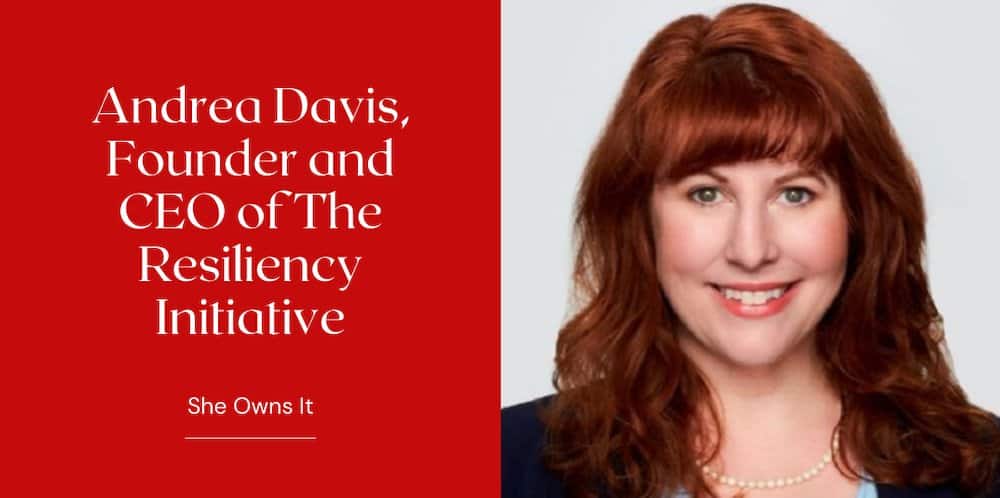
As the founder, president, and CEO of The Resiliency Initiative (TRI), Andrea Davis’ main objective in life is to build resilient communities around the world by providing bespoke, scalable crisis management solutions. Her engagements with clients infuse their businesses or communities with the confidence to handle any crisis situation that arises.
“Invest time in determining what drives you. Define what matters most to you, then go and get it!”
– Andrea Davis

Can you tell us more about your story and how you got to where you are today?
From humble beginnings as a single teen mother navigating college while working graveyard shifts as a waitress, I embarked on a journey fueled by resilience and a fervent commitment to community empowerment. Today, as the Founder, President, and CEO of The Resiliency Initiative (TRI), a certified Woman-Owned Small Business (WOSB), I stand as a beacon of strength and resourcefulness, dedicated to helping individuals and businesses thrive amidst adversity. With over two decades of expertise spanning emergency management, business continuity, and public health, I have traversed diverse sectors and geographical landscapes, leaving an indelible mark on the field. From leading crisis management efforts for global corporations like The Walt Disney Company and Walmart to steering recovery initiatives in the aftermath of Hurricane Katrina as the External Affairs Director for the Federal Emergency Management Agency’s Louisiana Recovery Office, my career is defined by unwavering dedication and impactful leadership.
My passion for volunteerism has garnered recognition, earning me prestigious accolades such as the Inaugural Emergency Manager of the Year by the International Association of Emergency Managers and induction into the Women’s Emergency Management Hall of Fame. Currently, I serve as Board Chair for the California Resiliency Alliance and the Northwest Arkansas American Red Cross, while also lending my expertise to organizations like the Institute for Diversity and Inclusion in Emergency Management (I-DIEM) and the Dr. Lucy Jones Foundation. Through my tireless efforts, I continue to shape a future where resilience is not just a virtue but a way of life.
What are some of the crises you’ve helped your clients navigate?
Many of our clients are currently prioritizing the development of strategies to address active assailant scenarios. Planning for how to respond to such a crisis is undeniably one of the most complex challenges they face. The appropriate actions often hinge on one’s proximity to the threat, and even contemplating such a distressing scenario can be emotionally taxing. Nevertheless, guiding our clients to step back, evaluate, and strategize on how they can effectively prepare themselves and their teams can instill a sense of empowerment.
What made you decide to go into business for yourself?
Two years ago, I made the bold decision to depart from Corporate America and fully commit myself to running TRI. Despite holding a prestigious title, managing extensive responsibilities, and enjoying a generous salary, I discovered a profound dissatisfaction within me. Witnessing the devastating impact of COVID-19, particularly on small businesses and organizations, deeply affected me. It pained me to see doors closing, communities struggling, and people in need of support. Driven by my lifelong passion for aiding others, I recognized my unique ability to maintain composure in the face of emergencies and guide individuals through their darkest days. This realization fueled my determination to take action and make a meaningful difference.
Does your company help the community where it is located?
Yes, I am a big believer in paying it forward. Philanthropy bolsters a community’s resiliency on a micro and macro level. Here at TRI, investing in community resiliency is one of our core values. TRI has committed to donating staff time and a portion of TRI’s revenue to support emergency preparedness efforts around the globe.
What can you tell our readers about what’s next for yourself and your company?
In 2024, we are launching two very exciting initiatives, both focused on supporting small businesses.
First, we opened an online store, giving businesses access to cost-effective and do-it-yourself options to help foster their organizational resiliency. We offer proven, state-of-the-art templates, manuals, and playbooks developed and used by my team. Utilizing the resources on our website, small business owners will have the ability to walk through the steps of initiating a robust crisis management strategy tailored to their business needs and kickstart their path toward resiliency. Additionally, we are offering access to our crisis management experts at discounted rates.
Secondly, we developed a two-day in-person training workshop specific to crisis management for businesses – The Resiliency Academy. We currently offer the workshop in two formats- on-site at a specific business location or in a group setting with other businesses. We are working on launching virtual options in the fall. The two-day workshop encompasses all-hazards preparedness and is meticulously crafted to empower employees and business leaders, enabling them to effectively prepare for, respond to, and recover from any variety of crisis events. These academies are fully customizable to cater to the unique needs of any business, ensuring alignment with their environmental, social, and corporate governance principles.
What advice would you give your younger self when starting this journey?
Recognize your strengths and leverage them.
I am dyslexic and wasn’t diagnosed until I was an adult. School was challenging for me and when I was made fun of for misspelling a simple word or mispronouncing something, I would take it very hard. Instead of embracing my inherent gifts—my vibrant imagination, adept storytelling prowess, and commanding presence in public speaking and theater—I internalized criticism and expended precious energy attempting to conform or excel in areas where I lacked natural aptitude.
What would you consider your biggest accomplishment and why?
Seeing and promoting talent.
Upon departing Corporate America, I understood that launching TRI single-handedly wasn’t feasible. Turning to a former colleague who constantly demonstrated innate leadership abilities and exhibited the value of compassion – a core principle on which I founded my company – I extended an invitation to join me in going “all in,” and she eagerly accepted.
Subsequently, I persuaded several former associates from my previous tenure to come aboard this exhilarating journey. Each of them embodies exceptional leadership in their respective fields and they hold dear my core value of compassion, collectively forming the cornerstone of TRI and setting us apart in the realm of crisis management consulting.
What challenges have you faced in the workplace, especially your experience in male-dominated environments?
I started in the crisis management field in 1999 (Y2K planning because the world was ending!), I had dropped out of law school and had no formal training in the field so my place at the proverbial table was questioned on day one. As I worked my way up and went back to school for a master’s degree in public health and homeland security, I was fascinated by the continued sexism and bullying behavior I received from men and women. It didn’t matter what job title I had or what sector I worked in; it was a constant undercurrent. As I got older, it became white noise because I was much better at identifying the behaviors and did not want to invest any time or energy reacting to small and insecure people. I found the most critical strategy for fostering inclusivity within an organization is to cultivate a culture centered around asking, “Who is missing from this table?” By actively seeking out diverse voices and perspectives, organizations can enhance their decision-making processes and foster greater confidence in their outcomes.
I am very passionate about helping individuals deal with workplace issues. In fact, I wrote a professional development, self-help cookbook about my experiences of working in a male-dominated field called I Only Remember Grievances and Desserts: What I Have Learned From The Cretins, Douchebags and Vipers so Far. Additionally, as a side project, I just launched a Q&A website to help professionals navigate the good, the bad, and the ugly of the working world.
How do you set your business apart from others in your industry?
TRI stands out in the crisis management industry due to our unparalleled expertise and personalized approach. With a combined experience exceeding 200 years in emergency and crisis management across various sectors, including Fortune 500 companies, government agencies, the military, and non-profit organizations, we bring a wealth of knowledge to the table. Our team has navigated through numerous real-world disasters, including but not limited to the 2023 Maui Wildfires, the COVID-19 pandemic, the 2020 Domestic US Civil unrest, the 2019 El Paso mass shooting, the 2017-2021 West Coast Fires, Hurricanes Ida, Maria, Irma, Harvey, Sandy, and Katrina, the Deepwater Horizon Oil Spill, 9/11, and the 1994 Northridge earthquake. This extensive track record underscores our ability to provide effective solutions and support during the most challenging situations.
Any final advice you’d like to share?
I’d like to leave with a piece of advice for anyone contemplating starting a business. My advice is to take the leap, but first, ensure there’s water in the pool before you jump. In other words, validate the need for whatever your business will offer, build up enough financial reserves to weather lean periods, and invest in hiring individuals who complement your strengths and serve as your guiding advisors, much like Jimmy Cricket.
“Never let a challenge or crisis define you. Look at it as an opportunity to think about a problem differently; you will be amazed at what you learn. You will see how strong you are, you will know immediately what is important and worth fighting for, and you will also know what is not worth wasting your time on.”Never let a challenge or crisis define you. Look at it as an opportunity to think about a problem differently; you will be amazed at what you learn. You will see how strong you are, you will know immediately what is important and worth fighting for, and you will also know what is not worth wasting your time on.”
– Andrea Davis
Want more inspiring interviews?
We love spotlighting amazing women! Check out these interviews (plus so many more) on She Owns It.
Meet the Entrepreneurial Sisters Behind Season 2 Consign. Get the scoop on Courtney Bagby Lupilin the go-to talent manager for reality TV stars. Discover Entrepreneur Courtney Ikerd of Somerset Candle Co. Read a Q&A with Founder Sharnell Ellerby or about Arina Ponomareva who is empowering female founders.
All of these and more are part of our interview series spotlighting successful women in business.

Melissa Stewart is the founder of SheOwnsIt.com. She is a Purveyor of Possibility, Entrepreneur Advocate and Coffee Addict. She believes that behind every successful woman is her story. What’s your story?